| Famous, Eventually |
| Scene, Stealers |
| Pixels, Popcorn |
| Cult, Actually |
| Franchise, Flogged |
| First, Role |
| Rewind, Corrected |
Reese Witherspoon is known worldwide as Elle Woods… but her early career was nothing like the bright, pink rom-com image people remember.
Read transcript
The world knows Reese Witherspoon as Elle Woods - the bright, pink-clad rom-com sweetheart.
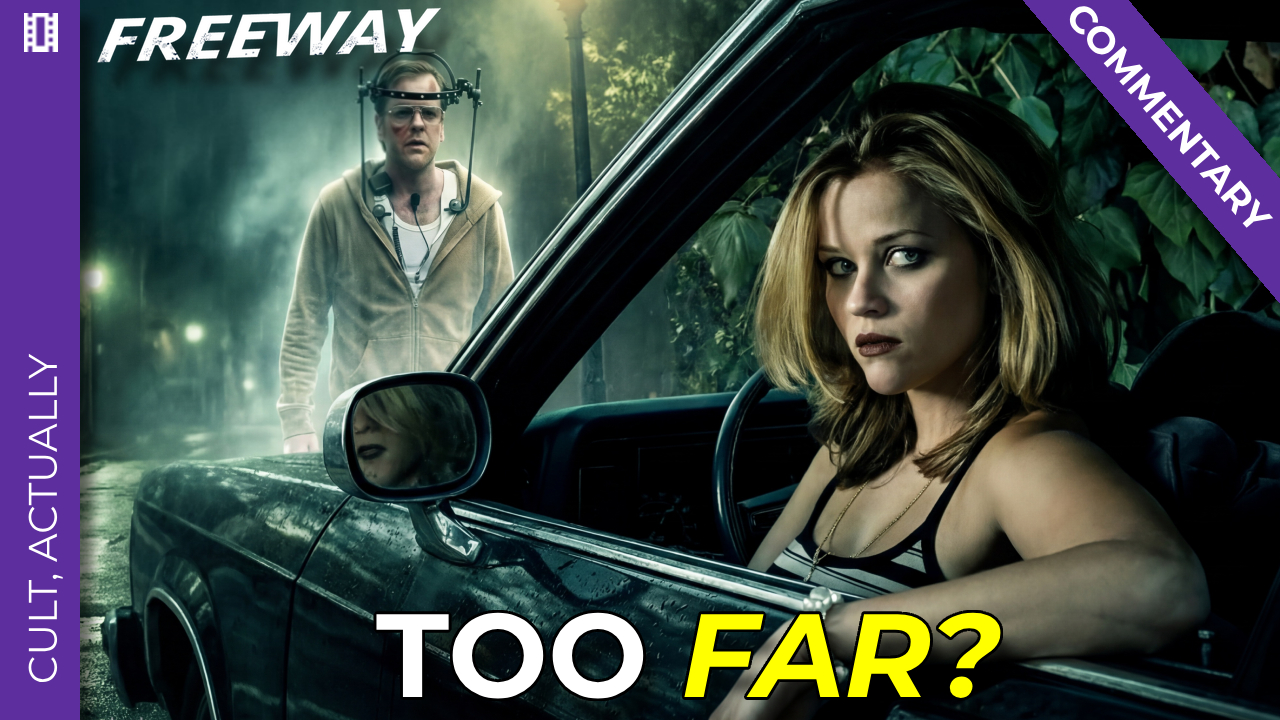
But before she ever set foot in Harvard Law, she played a violent teenage Little Red Riding Hood who murders a serial killer with a screwdriver in the cult film Freeway.
Her early career wasn’t light at all - it was darker, stranger, and on a completely different path than most people remember.
Let’s take a look at how Reese Witherspoon got Famous, Eventually…
[Intro]
Her starting line, a role almost nobody saw, was The Man in the Moon back in 1991, when she was only fourteen.
Originally she’d auditioned just to be an extra, but the director, Robert Mulligan, caught sight of her tape and decided he wanted to take a chance on her.
He’d later call it a risk, but he’d seen something in her that he thought could work, and cast her as Dani Trant - the lead of the film.
She ended up carrying half the movie on her own.
It’s a coming-of-age film that’s still fondly remembered today. Critics noticed her, but not many others did, weirdly.
After that it was TV movies and the kind of films you vaguely remember renting when nothing good was left on the shelves in the early 90s.
Wildflower, Solomon’s Choice, Jack the Bear - you know the ones. Decent, sometimes, but nothing you’d rave about.
Then S.F.W. in 1994 - the first time I really noticed her.
A film that tried to be the anthem of early “Generation X” cynicism before anyone even knew what that was.
It didn’t connect with audiences, but the people who did see it at the time… they got it.
On the surface it’s a hostage drama, but really it’s about apathy, media obsession, and a generation that couldn’t be bothered pretending to care anymore.
Stephen Dorff plays Cliff Spab, the accidental anti-hero who goes viral - before “viral” was even a word people used.
Reese plays Wendy, one of the hostages who gets dragged into Cliff’s sudden celebrity.
It’s a small role in the grand scheme of her career, but you can see an early version of the dramatic instincts she’d rely on years later.
She isn’t bubbly, not charming - just raw, disaffected even, and stuck in the fallout of something she never asked for.
The film didn’t land commercially - wrong time, wrong mood, wrong marketing - but it pointed her straight toward the darker material she’d really break through with next:
Freeway.
This one is basically a twisted, modern take on Little Red Riding Hood.
Reese plays a teenager from a rough home who ends up on the run, trying to track down her grandmother.
She hitches a ride with Bob Wolverton, played by Kiefer Sutherland - a man who seems polite and trustworthy, but turns out to be a predator who targets girls he thinks nobody will miss.
She survives the encounter, but the film takes a sharp turn after that, following her through a string of chaotic, violent situations as she tries to get her life back under control while everyone else treats her like the problem.
It’s a great watch - like S.F.W. it probably should’ve done better than it did.
But then I guess it wouldn’t be a cult film, would it?
The same year she’d star in Fear, a Mark Wahlberg vehicle - but this one got her noticed properly for the first time.
He’s doing the unhinged boyfriend / stalker thing here. It’s not a bad movie, a little dated now because it’s been done to death, but it worked at the time.
If anyone had seen S.F.W. or Freeway when they released, they wouldn’t have been surprised to see Reese here.
But most didn’t - so this was the first time a wide audience saw her play someone who wasn’t… well, homely, for want of a better word.
Not a breakout, but people definitely started paying attention.
From then, she plays a blinder.
Her next major project, Pleasantville, was another film ahead of its time.
It did well enough back then, but it’s more appreciated now - mostly because people finally caught up to what it was doing.
It was never a subtle message the film was trying to send - it’s a story about conformity, censorship, and tolerance wrapped up in a black-and-white 1950s sitcom world.
Audiences in 1998 saw a quirky and clever fantasy - but today it plays like a much sharper commentary on identity, repression, and who gets to decide what is acceptable in society.
Reese plays Jennifer, a modern teenager dropped into the whole thing - her modern thinking is a challenge to the supposedly perfect town of Pleasantville, and she ends up being one of the major catalysts for their new ways of thinking.
It’s a mix of comedy, fantasy, and drama, and it showed she could do all of that at once - confident, funny, rebellious, and still grounded.
It wasn’t her film exactly - but it’s yet another small role where she made a huge difference.
Then Cruel Intentions - a teen remake of Dangerous Liaisons. Reese wasn’t the headline name; more attention was on Sarah Michelle Gellar and Selma Blair, because - well - yeah.
But Reese was the moral centre of the film, and she added a weight to it that could’ve easily collapsed in on itself.
It quietly helped her at exactly the right time.
That was her next film: Election.
Now this is the one that genuinely changed things for her.
Election is one of those films that still holds up today. It shone straight from the start, with Reese’s Tracy Flick being the reason why.
Sure, Alexander Payne crafted a masterful satire, but Reese flipped the table with her performance.
It’s a dark comedy set in an American high school where a student council election turns into a full-on war.
Tracy Flick is an overachiever determined to win at any cost.
Smart, organised, relentless - she runs like it’s a national campaign.
Her teacher, Jim McAllister - Matthew Broderick - can’t stand her ambition and decides she needs to be “taught a lesson,” bringing in a rival to try and stop her.
What should’ve been harmless fun spirals into sabotage, manipulation, moral collapse, and a battle of petty egos.
Tracy outwits everyone simply because she’s prepared to go further than they are.
It all works because Reese has this laser-focused intensity. She’s unstoppable, and you can’t quite tell if she’s the hero or the villain.
She was brilliant - critics loved her. Suddenly she wasn’t just “promising.”
Directors finally saw what she could do.
Then came Legally Blonde - the jump from respected to mainstream.
She’d proven she could act; this is the film that made her a household name.
She plays Elle Woods, a sorority girl with her life mapped out until her boyfriend dumps her because he wants someone “serious” and he’s off to Harvard Law.
She decides to prove him wrong and show everyone she’s not the stereotype they think she is.
And this is where Elle’s story flips - she is competent.
More than competent, in fact.
And anyone who underestimates her is in for a shock.
She throws herself into a major legal case, outthinks the students who mocked her, outworks the professors who underestimated her, and proves she belongs at Harvard because of her ability, not her image.
The comedy’s there, but the core is surprise - she looks like the punchline, then quietly becomes the person holding the whole story together.
But in pink.
Legally Blonde didn’t just make Reese a star - it locked her into the Hollywood machine.
She suddenly became the go-to for studio comedies and rom-coms, and she could’ve leaned into that completely if she’d wanted.
But she didn’t.
After a brief flirtation with them, she started drifting back toward drama just as quickly as she’d landed in the comedy spotlight
She clearly was still aiming for something bigger than the stereotype she’d just been handed.
Kind of ironic - she’d already proven she could act, but it took Legally Blonde for everyone else to take her seriously.
Life imitates art, right?
She pushed into more serious roles, took chances, and then Walk the Line happened.
She played June Carter to Joaquin Phoenix’s Johnny Cash - the anchor to his life.
The film tracks his rise, addiction, collapse, and long road back, with June trying to hold the pieces together.
Reese doesn’t play her as “the love interest”; she plays her as someone with her own life, career, and spine.
It completely redefined how people saw her - sharp, grounded, emotional without being sentimental - and it won her an Oscar.
It gave her a second wave of credibility.
No longer “the blonde,” no longer “the ditzy lead.”
She began shaping her career back into the one she initially set out to carve.
After that, she got more deliberate.
Misfires, sure, but also risks: smaller films, tougher material - things that didn’t scream “Reese Witherspoon, movie star,” but absolutely showed what she could do.
Then she made Wild - and not just starred in it, she made it happen.
Produced through her own company, Pacific Standard, it was one of the first projects she took real control of - and it worked.
Wild is based on Cheryl Strayed’s memoir about her solo hike along the Pacific Crest Trail - a thousand-mile walk she took after her life basically fell apart.
Reese plays her without gloss. No glamour. No soft-focus inspiration.
It’s messy, uncomfortable, and stripped back on purpose.
The film jumps between the trail and the moments that pushed her there - grief, bad decisions, the sense she’d run out of ways to keep her life together.
Reese carries almost the entire film on her own - injuries, fear, loneliness, the quiet slog of keeping going.
And she doesn’t play Cheryl as a martyr - just someone trying to put herself back together one step at a time.
Another Oscar nomination.
Another reminder she could still take risks.
Stripped back, vulnerable, nothing to hide behind.
She wasn’t done evolving.
Then she started producing more: Gone Girl, Wild, Big Little Lies - projects driven by women, the kind Hollywood rarely funds unless someone powerful forces the door open.
By the mid-2010s she wasn’t just acting in hits - she was making them happen.
And that’s where she sits today:
A long way from the fourteen-year-old in Man in the Moon.
Still acting when she wants to.
Producing some of the biggest prestige TV of the last decade.
Shaping the industry in a way most actors never manage.
Not the straight line people think.
Not an overnight story.
She was doing darker, stranger, tougher material long before Hollywood handed her a pink wardrobe - but that’s the part people forget.
Just a career built in phases - steadily, deliberately - until she became one of the most recognisable actresses working today.
If you liked this video - Do me a favour, drop me a like and let me know.
Subscribe as well if you want while you’re there, that’d help the Channel out - Or - Don’t - I’m not going anywhere.
Anyways… I’ve been Paul and Reese WItherspoon was Famous, Eventually.
Thanks for watching.